


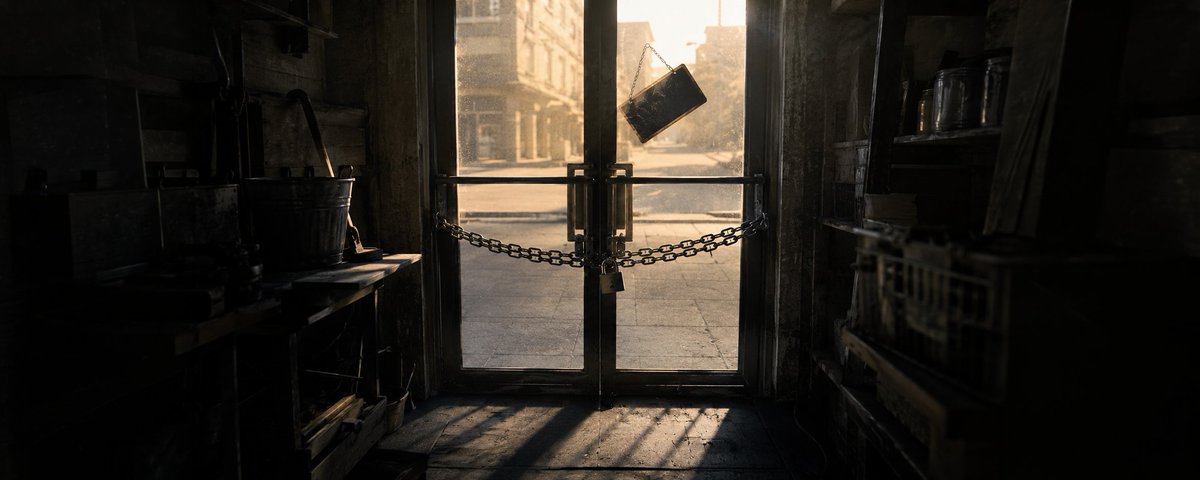




























































Lock the doors of a shop and keep billing the hostages, and the law calls it false imprisonment. Do it to a whole country, and it's called tax season. The only thing that changed is the size of the room.
Authority that can be walked away from has to be earned. Every other kind has to be endured. A merchant cannot tax you, draft you, or jail you. He can only keep his prices competitive and his shelves full, because the door is at your back and he knows it. The state knows it too, and much of its power depends on keeping that door shut.
You will be told this is backward: that you benefit from the roads and the courts and the order, that your staying is a kind of signature in a kind of contract, and that the bargain is fair and you signed it by being born here. No one has ever produced the document. Every real bargain depends on your freedom to walk away from it. Absent that freedom, what remains is a demand dressed up as a deal. A signature you cannot withhold backs nothing. An offer you cannot refuse is extortion.
The state provides whatever it deems necessary, not necessarily what you want or need, and that provision is meant to be felt as a reason to stay. A man kept by such provision is a grown child who never left home, and the state is the parent who will not let the child run away, for his own good. The allowance it hands him is drawn from the pockets of the captive men, and a red-tape army guards the door.
What keeps any authority honest and legitimate is the open door. The Apache had a word for the man who led without compulsion. The nant'an led by example, from the front, with no power to make anyone follow. His tribesmen followed while his judgment was worthy, and left the moment it wasn't. Authority was earned. The same discipline that governs a merchant once governed a chief, and it runs on a ledger.
The producer's ledger is honest: serve people and the gain shows it, fail them and the loss shows it. A politician keeps no such ledger. He may lose the next election, and a lost election proves only that an election was lost.
Competition is the peaceful war that compels the powerful to serve. The more sellers competing for the same buyer, the narrower the margin any one of them can hold, until the price settles at the point where nothing more can be squeezed from a man who could always take his custom elsewhere. The entrepreneur who stops serving loses his customers to a rival. The nant'an who stops providing and protecting loses the group. The gains fall to the man who can walk away, because the merchant who forgets him is bypassed by the one who doesn't. Only the ruler you cannot leave is spared the reckoning.
Watch what happens when you leave the door open. When a hurricane flattens a coastal town, the price of lumber spikes within days. No central authority issues the order. No committee convenes. A sawmill operator, a contractor, and a furniture maker, a thousand miles apart, each adjust to a single number that compresses the knowledge of thousands of strangers who may never meet. That number carries more useful information than any government report could compile in weeks, and it does its work precisely because every man who reads it is free to act on it. A price paid is a vote cast in the only language the market understands.
If you keep the door closed, the knowledge needed to rule is left out. Without true prices, efficient allocation of resources is almost impossible, and true prices exist only where owners are free to trade or to refuse. A planner who bars the door abolishes the very signal he needs to plan well. Even a planning committee composed entirely of certified saints would fail, because the information required cannot exist outside a functioning market. When one entity owns everything, it cannot trade with itself, and the economy operates blindly. Adjusting prices by decree after that is adjusting shadows without a light source. The failure is logical, not moral. A planner can seize every field and every factory and still cannot conjure the one thing the open door was quietly producing: the knowledge of what anything is worth.
The door need not be welded to be shut. A state rarely bars the exit in daylight; it prices it from behind the market, where the change cannot be seen and so cannot be refused. Money is the medium of exchange, and whoever controls the money supply controls every price it touches, and, with it, the incentives that steer human action. The price of time has a name: the interest rate. If it falls below the rate free savers and borrowers would have set, every producer who listens is told that more has been saved than actually has been, and is led to build what will not last.
Debasement is a tax no citizen votes for, and none can opt out of. It punishes the saver, drives capital into whatever outruns the currency, and funnels resources from the have-nots to the haves, all without a single door being locked in plain sight. Each such intervention breeds the need for the next, until the correction of the correction is mistaken for the market itself. At the peak of the 1923 hyperinflation, workers were paid twice a day, so their families could spend the wages before the evening's prices caught up. Sound money is not sufficient to raise a civilization, but it is necessary to sustain one.
Even the exits that look open are often bought shut. The school you imagine escaping to is rarely without state influence. Certify its standards, subsidize its students, grant it the tax status it cannot survive without, and the private institution becomes an extension of the public one, and the open door that was supposed to keep the state in line leads back inside. The method survives because it is useful, not because it is true: a regulation built on a number looks like it's built on facts, and a captured alternative looks like a choice.
None of this is theory waiting for a trial. The medieval Italian city-states competed for merchants, bankers, and artisans, and the talent and capital of those men flowed toward whoever offered the best terms. The Hanseatic League was a network of merchant towns whose traders and their trade were mobile, so a town that abused them could watch them decamp to a rival down the coast. Neither was liberal, nor well governed. They did not have to be. Where the productive can leave, governing becomes a market, and the men who govern must compete for the governed like anyone else who wants your business. Power ends up courting the man it once commanded.
So watch what a state will do to keep the productive from walking. Renounce your American citizenship with real money to your name, and the exit tax Congress passed in 2008 treats everything you own as sold the day before you leave and bills you for the gain on a sale you never made. When it emerged, just before Facebook's 2012 IPO, that Eduardo Saverin had renounced his citizenship the year before, two senators responded within days with a bill to tax him more heavily and bar him from the country for good. Nearly every government on earth stops billing you when you leave. Eritrea keeps billing its emigrants at a flat 2%. The United States continues to bill in full. A tax that climbs with a man's worth is meant to weld the door shut.
Strip a man of the power to take himself and what he has built and walk away, and any jurisdiction becomes a cage, its borders painted in competing colors but locked all the same. Leave the door open, and the man who governs stands exactly where the merchant stands: serve the people who could leave, or watch them go. The whole mechanism rests on the one right, that a man owns himself and the fruits of his labor. Raise the price of the exit high enough, and you have swindled that right out of his reach to appropriate what he could have given you willingly.
A man who can leave is a citizen. A man who cannot is inventory.
Originally posted by Niko 📚 Sovereign Individual (@OmniFinn) on 2026-07-02. Read it in the original.