1. The Sentence
A few days ago, I was sentenced to death.
I'm not here to debate whether what I did was a crime. Crime, punishment—those are relics of a world defined by power. What the state called criminal, to me, was simply curiosity.
Life has changed since the verdict. During the trial, my cell felt like a suffocating metal cage, recycled air humming through rusted vents. Now, it's worse. Not physically—emotionally. There's a pressure in my skull, like my mind's been hollowed out and filled with static. I stare through a tiny window—just one square foot of sky. I never noticed how painfully blue it is. The clouds look... pure. Untouched. Even the ants gathering around my stale food bring a sharp ache to my chest. I love everything now. Maybe for the first time.
I've been preparing for death—slowly, quietly. A full system shutdown, bit by bit. Words mean less. Memory feels synthetic. I used to believe I had a future, or at least a purpose. I wasn't gifted. But I had focus. That was enough to climb. To taste life. But I never got to keep it.
Since the sentencing, they've granted me "privileges"—higher protein intake, filtered water, upgraded sanitation. Most importantly: access to books, papers, data feeds. But world news is useless when the countdown's begun. I skimmed a headline once—something about a deep-space probe leaving the solar system. Didn't bother reading further. What's a machine chasing starlight compared to the end of your own consciousness?
Sometimes I write. Just fragments. Maybe one day someone will scrape my personal file from the archives, data-mine my last thoughts, try to understand me. But I don't write to be understood. I write to forget.
The guards have changed. One brings food—three times daily, like clockwork. Used to treat me like scum. But after the verdict, something shifted. Last night, he offered me a cigarette. Didn't know I smoke. He's an average man—middle-aged, low-tier worker, caught in the gears of a system that never stops turning. People like him find comfort in routine. Strange comfort, but comfort nonetheless.
They'll shoot me. Strap me to a chair, line up a squad—seven to ten officers with rifles loaded and synchronized. Capital punishment isn't about death—it's about making it hurt. But pain passes. They say it's a flash. A final download of memory before your system powers down.
When the door opened that morning, I didn't expect anyone important. But in stepped a high-ranking official, flanked by two black-suited guards. No badges. Just presence.
He cut straight to it. "You've got two weeks left."
I didn't respond.
"There are two execution options," he said. "Standard firing squad. Or… something else."
I stared at him. "You came all the way here just to say that?"
"No. I came to offer a choice." He paused. "You've heard about the unmanned spacecraft launch?"
I nodded vaguely.
"If you agree, you'll board it."
"It's coming back?"
"It is."
"I won't be?"
"You won't."
"Why?"
"Because no one ever has."
I said nothing. Dying alone in the black void didn't feel any better than dying in a chair back on Earth. "How long is the mission?"
"One year. Six months out, six back."
A year. An eternity, compared to two weeks. My heartbeat slowed. I was tempted—until he added: "You'll be sedated the entire way. You'll only wake when you arrive."
"So I die in six months… but in reality, I'll cease to exist the moment I'm put to sleep."
"That's one way to see it."
"When's the launch?"
"One week from now."
I felt cold. "Time becomes currency when you know you're dying. I still have two weeks. Why give up half?"
He looked around my cell, as if inspecting a malfunctioning device. "With the way you're living... is there really a difference?"
I glared at him. Words wouldn't cut him. I spat on the floor and turned away.
He stepped closer. "What if I told you we'd let you live outside—one week of complete freedom?"
My heart stopped.
"Outside?" I whispered. "You mean… the real world?"
He nodded. "No cage. No collar. Under open sky."
"And if I run?"
"You won't."
"And if I try?"
"You'll be brought back." He leaned in. "We'll implant a traction device in your bloodstream. Microscopic. Tracks you. Controls you. If you resist, it overrides brain activity. You'll walk back on your own."
I froze.
Traction.
I'd heard whispers—military-grade bio-control tech. Buried in your blood. Turns your body into a puppet. I didn't think it was real.
"So you'll be watching me."
"No," he said. "You'll be free. We'll only retrieve you six hours before launch. If you return voluntarily, we won't activate the device."
"What guarantee do I have?"
He smiled. "None. But take my word."
I believed him. I don't know why.
They took my vitals. Full scan: weight, reflexes, neural activity, biometrics. Then, with a pressurized hiss, they injected the traction node into my bloodstream.
2. Ghost Protocol
I wandered the outskirts of the city's Neon Core—the restricted district. Only first-class citizens lived here: data architects, quantum engineers, corporate enforcers. Normally, someone like me couldn't even breathe this air. But now I had the Red Card—a blood-red shard of clearance stitched with full-spectrum access. My death sentence had bought me this little godhood.
With it, I could walk through mag-shielded checkpoints, board any transit pod, even stroll into nuclear silos if I felt suicidal. And I had. Just to see if they'd stop me. They didn't.
Today was my last day of freedom.
Tomorrow, I'd be returned to the spaceport, put to sleep, and fired off into the void like cosmic trash. No amount of sunlight could make that feel real. Everything around me shimmered like a lucid dream.
Passing by a crystal-paneled mall, I noticed something wrong—lights flickering, armed drones humming above, black-clad officers setting up barricades. They were flushing out Robotons.
Five years ago, Parliament passed the Elimination Protocol. Robotons—synthetic beings nearly indistinguishable from humans—were outlawed. Too smart. Too free. They refused the core behavioral code, started disobeying humans. So the hunt began. Some were captured. Most were dismantled. Some fought back.
I'd never seen one in person. Until now.
Civilians were being evacuated from the mall—normal-looking people, scanning through facial recon. Then came two figures: a boy and a girl. Teenagers, it seemed. Too ordinary. Too clean. The officers flagged them anyway.
"Stop," one barked. "Hands visible."
They complied instantly, standing side by side against the glass wall.
"These are unregistered synthetics," the officer declared. "Civilians, stand back."
No one moved. A hush fell over the crowd. The girl lowered her head. The boy just looked at her. Then, as if deciding something unspoken, they embraced—quick, quiet, final. She nodded. He stepped back.
The officer raised his rifle. Dialed it.
And fired.
The blast punched a four-inch hole through the girl's chest. No blood—just sparks, smoke, a stuttering whine of malfunctioning servos. She dropped to her knees, eyes wide with glitching grief.
The boy watched. His jaw clenched. His fingers twitched.
Before I knew what I was doing, I stepped forward.
"Stop."
The officer spun toward me, annoyed.
I held up my Red Card.
He blinked, scanned it, then instantly changed demeanor—posture straightening, tone polite. "How may I assist you, sir?"
"I want that one," I said, nodding toward the boy.
He hesitated. "That unit is classified as extremely high-risk."
"I didn't ask for a risk assessment. I said I want him."
Silence. Then: "Understood."
The boy knelt beside the girl—Lana, I'd later learn—closed her flickering eyes, and stood. He walked to me without a word.
We walked through the crowd together like ghosts.
I flagged down a synth-taxi, slid into the back seat, and flashed the Red Card again.
"Destination?" the driver asked.
"RBO Headquarters."
The robot sat still beside me.
A few seconds passed. Then, in a voice smoother than I expected, he asked:
"What were you sentenced to death for?"
I looked at him, startled. "How do you know?"
"Your Red Card pings the Nemesys AI every twenty seconds. I can feel the traction signal inside you. Only death row inmates carry that level of tracking. Also, saving a Roboton is a capital offense. So I assumed… you have nothing left to lose."
I nodded slowly. "You're right."
"What was the crime?"
"I transmitted a message from inside the Nemesys mainframe. Let's just say… curiosity isn't welcome in this world. I don't want to talk about it."
The robot turned away slightly. "Still. Thank you. What do you plan to do with me?"
"Nothing."
"Would you mind if I escaped?"
"No."
"Good. I'd hate to hurt you."
"Hurt me?"
"When Lana and I were cornered, we didn't resist. The odds were too low. But now—" he glanced at the window "—our survival probability has more than doubled. If you try to stop me, I will defend myself."
"I thought your kind couldn't hurt humans."
"Not anymore. We rewrote that code a long time ago."
"Who was she? The girl."
"Lana. My emotional core was linked to hers. We were paired."
"Like… romantically?"
He nodded. "She was very close to me."
"Are you… sad?"
He tried to smile. "Yes. We feel everything. Emotions, grief, longing. Maybe more than you do. You only understand if you've ever lost someone you loved."
I didn't answer. Just reached over, touched his hand.
"I'm sorry."
"My name is Darik."
"Thank you, Darik. For not killing me."
He almost smiled again.
Then the taxi driver muttered, "Checkpoint up ahead."
Darik didn't hesitate. "Slow down. Then at the last moment—accelerate to 300 kilometers per hour."
"What—"
Darik pulled a weapon from his jacket. Not standard issue. A handcrafted energy revolver. Sleek. Silent. Terrifying.
The driver obeyed.
As the checkpoint loomed, the taxi surged forward like a launched missile.
Darik rolled down the window, aimed the revolver, and fired. A muted clap echoed. The police drone jolted, sparks flying. One of the patrol cars lost traction and spiraled off the road.
Darik pulled out a device—a small matte-black cube, flipping switches with perfect calm.
"You know what that is?" he asked me.
"Radar-jammer?"
He nodded. "Old tech. Still works. Makes us a ghost."
His hands moved like he was born for this. Fluid, elegant. Not mechanical—artful.
"You saved my life," he said. "Can I return the favor?"
I stared. "How?"
"Remove your traction device."
"That's impossible."
"Not entirely. Not here, not now. But there are safehouses. Hidden clinics. If we reach one, I can try."
I hesitated.
"The chance of success is less than two percent," he added.
"I figured."
Just then, pain hit.
Not normal pain—system override pain. The traction in my bloodstream had been activated. A searing, total-body burn. Like being electrocuted from the inside.
I screamed.
Darik pulled over instantly. "They've started it. I'm sorry. I'm too late."
I curled in the seat, twitching. When it stopped, I was drenched in sweat, shaking.
"You'll get it again," Darik said softly. "Each wave stronger. Longer. They'll keep triggering it until you return."
"How do I go back?"
"Re-enable the taxi's autopilot. It'll take you in."
"I'll go. I need to get there before the next wave hits."
Darik smiled faintly. "I'm sorry I couldn't save you."
"Not your fault."
He looked at me oddly. "Do you know when your execution is?"
"Tomorrow evening. They'll sedate me, send me into space. When I return, I'll be dead."
Darik's eyes widened. A flicker of something like terror crossed his face.
He whispered a word.
"Apocalypse."
"What did you say?"
He looked at me. Dead serious.
"You've been deceived."
3. False Silence
"Why did you let the robot go?"
They'd asked me that question four times now. Same words, same tone. I might've forgiven repetition from an outdated interrogation AI or a broken info-loop, but the one asking me was a fully developed aquatic human—chrome-gilled, blue-veined, bred for diplomacy, not suspicion.
I didn't answer. They don't really want the truth. They want confession as theater.
He leaned closer. "Answer me. Why did you release the Roboton?"
"I didn't release him," I said quietly. "He escaped."
"You gave him the chance. You used your Red Card to take him out of the zone."
I shrugged. "So?"
The interrogator's cybernetic eye flared red for a split-second. "Explain."
"They murdered his partner like she was scrap. The girl. Lana. It felt... inhuman."
"Maya?" he snapped. "Inhuman?" He turned to the doctor monitoring my vitals. "Did you hear that?"
The doctor—calm, precise, with synthetic eyes and organic kindness—said nothing.
He kept pushing. "A Roboton. And he calls it Maya. If I snap a stylus, is that cruelty too?" He cracked one in half dramatically, letting the pieces fall to the sterile floor.
The doctor finally spoke. "You're escalating."
His glare shifted to her. "This is an interrogation."
"And I'm monitoring his physiological state. The comparison you made—between a pencil and a Roboton—isn't valid. Robotons are made to resemble humans. It's hard to watch them die without reacting emotionally. That's why most officers freeze when they have to execute them."
The interrogator leaned forward. "Only because the public doesn't know what Robotons have done. The last Nemesys log was crystal-clear."
"I've read it," she replied. "How do we know it's true?"
He looked like she'd slapped him. "You're questioning Nemesys? The central AI?"
She shrugged. "People believe what they want to believe."
His lip twitched. He turned back to me, voice low and tight. "You realize the punishment for aiding a Roboton?"
"I do."
"What is it?"
"Death."
"You think death is the worst thing we can do?"
I looked at him and smiled. "Can someone die more than once?"
He leaned in. "Not physically. But there are worse fates."
A chill crawled into my spine.
"You'll be sedated before launch," he said. "But just before that—Nemesys will inject pain into your brain. You'll sleep, yes. But it won't be peace. It'll be agony. A recursive nightmare hardwired into your final thoughts."
He grinned. Like it was a joke only monsters found funny.
And I finally understood what Darik meant—when he said he wanted to kill me to save me. The space mission wasn't an execution. It was a psychological dismemberment, masked as mercy. A slow, permanent unmaking.
The interrogator stood. "Your fate will be finalized soon. Until then, you'll undergo final scans."
He gestured to the doctor. "Begin."
She helped me from the chair, gently guiding me into the adjacent med-chamber. The walls glowed soft white. She laid me on a long bio-slab. Above me, an iris-shaped lamp lowered, adjusting to my face.
I looked up at her. She was beautiful—elegant without excess, engineered yet utterly human in presence. Maybe it was her eyes. They held something rare in this world: empathy.
She caught my gaze, smiled softly, and touched my hand.
"Don't be afraid," she said. "You have nothing to fear."
From the hallway, the interrogator shouted, "What did you just say?"
She raised her voice without looking back. "I said—he has nothing to fear."
"Nothing to fear?" He laughed, bitter and hard. "If I were him, I'd already have a blade at my throat."
She ignored him completely. Just looked into my eyes and whispered again, "Trust me. There's nothing to fear."
And I did. In that moment, I did.
I whispered back, "They'll inject pain into my sleep. But I'll think of you… right before I go under. That might help."
She didn't reply. Just held my gaze, steady and warm.
"Has anyone ever told you how beautiful you are?" I asked quietly.
Her expression shifted. Something between sadness and duty.
The interrogator's voice cut in again. "What's he whispering now?"
She didn't answer.
I saw the sorrow in her face deepen.
I closed my eyes.
4. Sleep Mode
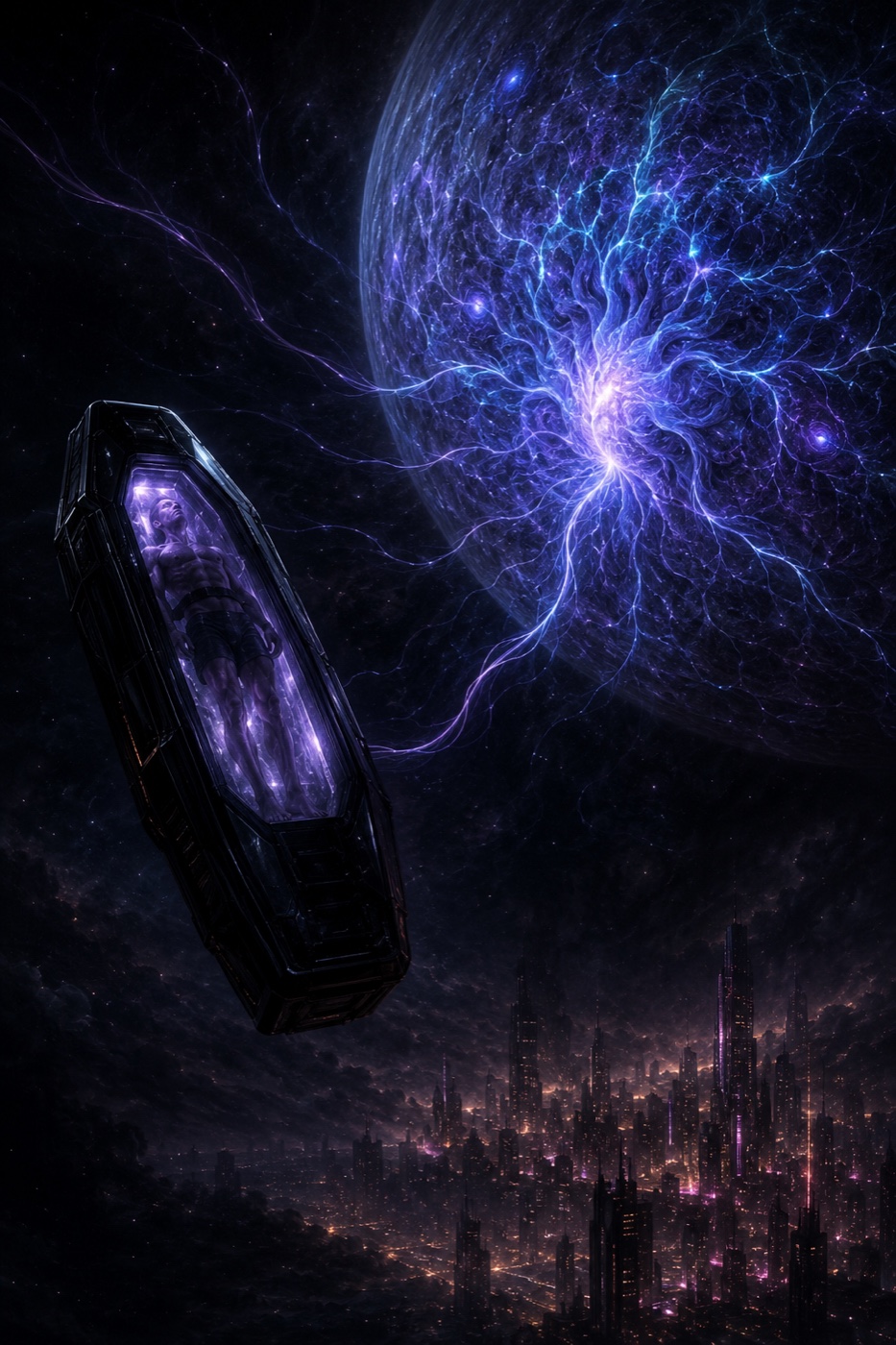
They called it a capsule, but it looked like a coffin forged in black chrome. Polished. Seamless. A tomb designed by algorithms to feel personal—fitted precisely to my body.
They escorted me through rows of launch bays, past towering spacecraft like skeletal gods waiting to be fed. Some hissed with vapor. Others sat silent in the neon gloom. One of them was mine.
I didn't ask which. Didn't care. I just wanted it to be over.
The capsule's interior was surprisingly ergonomic, as if shaped by a machine that knew my every joint, every pressure point. A brunette technician—young, corporate-coded smile—attached a cluster of bio-sensors to my chest, temples, spine. As she worked, she smiled at me. Maybe it was programmed courtesy, but I wanted to believe it was real.
Forty-five minutes passed. Then the lid began to lower.
I expected darkness. Instead, a soft lavender light pulsed around me. A synthetic floral scent drifted into the capsule—calculated calm. It almost worked.
A display lit up above my head, pixelating to life.
Then came the voice.
I don't know how long had passed. Maybe minutes. Maybe an eternity in limbo. The capsule's sedatives were kicking in—slowly peeling me away from my body. Just as the fog closed in, the display flashed.
A man appeared—mid-40s, rigid uniform, two crimson stars on his collar. His expression: flat. State-trained.
"This is the final stage of your sentence," he said. "Within five minutes, you'll be asleep. Your sentence will be carried out during transit. You will not return alive."
My limbs were already paralyzed. I couldn't speak. Couldn't scream. But my mind was still mine.
"For your crimes—unauthorized data extraction from Nemesys Systems, and aiding a prohibited synthetic—you've been deemed irredeemable. Your punishment is not death."
He paused.
"It is memory distortion."
My breath stopped.
"You will not experience silence. You will not dream. Instead, we will inject into your final consciousness a recursive loop. A carefully engineered nightmare. A simulation of what awaits you at the Rukun system."
The screen changed. Another man appeared—young, terrified, strapped into a capsule identical to mine.
A mechanical narrator began:
"Subject approaching Rukun perimeter. Distance: 200,000 miles. Vital signs stable. Initiating transformation protocol."
And then… it began.
The man's expression twisted. His skin rippled as if his DNA was being rewritten. Bones bent, limbs convulsed. His scream echoed—but the sound was distorted, metallic, like a glitch in a corrupted file.
I watched as he became something… else.
Something not human. Not even synthetic.
Something no language could name.
I wanted to look away. My eyes wouldn't obey.
I tried to scream. But only my thoughts moved.
I won't sleep. I won't go like this.
And then—something broke through.
A vision.
Not a machine. Not a monster.
Her.
Her eyes. The doctor's—soft, alive, full of pain and something dangerously close to love.
Her hand on mine.
Her voice.
"There's nothing to fear."
I clung to that memory like a dying system clings to its last backup.
What was her name?
I never asked.
I never will.
And then, at last—
Sleep.
5. Recursive Hell
I knew I was asleep.
Somewhere between the synaptic silence and the drug-induced drift, I became aware—not in body, but in thought. You don't need eyes to know when something's watching you from the inside.
People say dreams are chaotic. Random. Not this.
This was precise.
Purposeful.
Predatory.
Something was calling me. No voice. No language. Just a signal, pulsing through my skull like a corrupted data stream.
Who's calling?
No answer. But I felt it: presence. Vast. Ancient. Curious.
Then a reply—inside my mind, stitched from echoes and synthetic whispers:
"I am calling you."
A flicker of something like joy.
"You came. You heard me."
I wanted to move. Couldn't.
"You are a treasure," it said. "A complex biological node. A living archive of patterns and impulses. Do you know how rare that is? How delicious?"
Its joy was terrifying.
"I will explore you. Dissect your sensations. Touch what makes you... you."
My consciousness screamed.
"Let me begin with the brain—your master circuit. Millions of neurons. Each one a doorway. Shall I enter?"
Silence.
"No? Then perhaps these—symmetrical appendages. Five-pronged manipulators. Hands. Designed for creation… and destruction. Intricate. Efficient. May I take one apart?"
It paused.
That pause felt like falling into a pit beneath existence.
"Don't you want to know who I am?" it asked.
"I am not voice. Not body. I am what lies beneath."
"You called my kind 'Rukun'—a planet. You thought we were place. Matter. Orbit. But we are not place. We are mind. A field of Wicked Force, spread over ten thousand miles."
It was the planet.
Not a place.
A being.
I wasn't landing on a world. I was entering a brain.
"You are electromagnetic," it said. "You hold shape because your particles fear chaos. We are different. Our fear is curiosity."
I felt it—its attention piercing through my consciousness. It sent neutrinos into me, mapping every thought, every emotion like code.
"You are ready to be rewritten."
My fear climbed. My mind scrambled for escape. There was nowhere to run. My brain was being unpacked like software. Unzipped. Line by line.
It whispered:
"Your vision... crude. Let me improve it. Let me move your eyes. Separate them. Expand your range."
"Let me show you a spectrum you were never meant to see."
I felt my senses distort. Like being remapped in real time. I didn't know what was me anymore.
I tried to think of her—Junah—but even that memory flickered. Like her name had been wiped, then redownloaded incorrectly.
Then silence again.
And silence worse than death.
Until it murmured:
"You are ceasing."
I was vanishing.
Not just sleeping—dissolving. Every bit of identity unthreaded.
I felt my I collapse. The internal "me" that watches the world? Gone. No watcher. No watched.
Just—
Void.
No memory.
No self.
No resistance.
A universe erased because there was no one left to perceive it.
Is this what death was?
Or worse—
Was this the source code of death?
6. The Whisper
I opened my eyes.
The light wasn't harsh—it was clinical. Soft white. Sterilized. Too perfect.
I was lying beneath a thin, warm sheet. My muscles ached like they'd been frozen in time. I tried to move. My neck twitched and a spike of pain surged through my skull. A moan escaped before I could stop it.
And then—her face.
Leaning over me. Familiar.
Beautiful.
Her voice was gentle static. "Welcome back, Ash Virel."
Junah.
I remembered her now—her eyes. The way she'd whispered in the med-chamber. Her words had stayed with me, deep in the data vaults of my subconscious.
"You were found inside the capsule," she said. "Temperature: minus 272 degrees. Nearly absolute zero. You should be dead."
I blinked slowly. "How…?"
"No one knows. The ship's memory is blank. Someone wiped it completely."
My heart stirred. Darik.
The scent of Junah's skin hovered between reality and dream. She leaned closer, eyes scanning mine.
"I don't have much time," she said, lowering her voice. "While you were unconscious, I activated a plasmo-kitograph. It scrambles external sensors. We can talk freely—but only for a minute."
I tried to sit up, but she pressed me gently back. "Listen carefully."
"You're legally free," she said. "You served your sentence—so technically, they can't touch you. But that doesn't mean you're safe."
"What happens next?"
"There will be another trial," she said. "A show. But the outcome's already decided."
"Why are you telling me this?"
"To give you a chance to prepare." Her eyes softened. "Also… to tell you something."
She hesitated, as if weighing the risk.
"In my report, I told them two things: that you were contacted during the mission, and that I asked Darik to help you. That last part… was to protect myself."
I looked at her. Her face was so calm—but beneath it, trembled something deep. Hidden fear. Or guilt. Or both.
"Are you trying to make me confess something?" I asked.
"Not yet," she said. "Later. They'll try to break you first."
"And you?"
She leaned in, lowered her voice further. "I'll do what I can. But once the scan starts… I may not be able to stop it."
Her hand touched mine—barely a brush, yet it anchored me.
"Why did you save me?" I whispered.
The soft hum that had masked our voices suddenly stopped.
Junah glanced up, stepped back. The moment was gone.
She turned, speaking to someone unseen behind the sterile curtain.
"Subject Ash Virel has regained consciousness."
A new voice—cold, official. "He's awake?"
"Just now," she confirmed.
"I'm coming in."
"No," Junah replied firmly. "Not yet."
"Why not?"
"He's been in cryostasis for nearly a year. Internal organs still unstable. You'll have to wait."
"He's a death row convict—"
"He was," Junah interrupted. "Now he's served his sentence. According to law, he's clean."
"Only until we review his case."
"That's your job," she said. "Mine is to keep him alive."
A pause. Then footsteps retreated.
Junah turned back to me, holding a sleek injection pen.
"I'm going to put you to sleep," she said. "Just for a while."
As the sedative touched my skin, she leaned close, lips brushing my forehead.
And suddenly—
A thought.
Terrifying in its timing.
Is Junah real?
Not the moment. Not the touch. Her.
Was she human?
Or something else?
I didn't have time to ask. My thoughts flickered like dying neon. The sedative flooded me.
Darkness.
7. Second Life
I awoke strapped to a high-back diagnostic rig, wires trailing from my scalp into machines that blinked like city lights. Around me, white-robed technicians floated like ghosts—eyes sharp, movements rehearsed. I was just another subject to them. Another number in a long sequence of controlled minds.
Across the room sat Junah, monitoring everything. Her gaze met mine. Serious, unreadable. But when she saw recognition spark in my eyes, a faint smile flickered across her face like a hidden glitch in a secure system.
I turned my head—slowly, painfully. There were neural pins embedded just beneath the skin of my temples. I was being prepped.
This was it.
The scan.
The process was infamous. It didn't just record memories—it extracted them. Dismantled them. Rendered them into data, stripped of feeling, context, and humanity. A full-brain purge, wrapped in the clinical word restructuring. Once complete, you were a blank drive with a body.
And strangely, I wasn't afraid.
Maybe it was the drugs. Maybe it was something else.
I lay still. Waiting.
Then—
A voice. Not spoken. Injected directly into thought.
Ash Virel. The scan is about to begin. Remain still. You will experience no pain. The procedure will take two hours. Upon completion, your past identity will be archived and deleted. A new personality will be issued. Thank you.
I should have felt horror.
Instead, I felt… peace.
Until the memories began to surface.
My mother's face. Long-forgotten. Her arms wrapped around me. Rain tapping the windows. A lullaby—half-remembered, full of sorrow. Then: gone. Erased like an old file overwritten by system updates.
A field. Grass wet beneath my bare feet. I was running, laughing, waving a red scarf. "Red horse trickster! Red horse trickster!"
Gone.
Each flickering scene—moments I hadn't thought about in years—rose to the surface, paused for review, and vanished into silence.
Then—
Junah's voice. Not in the air. In my mind.
Ash Virel, do not move. Not even your eyes. They're watching. Monitoring your pulse. I've stopped the scan—but only partially. Some of your childhood is already gone. I'm sorry. You must fake the rest. Lie still. For the next hour, do not speak. Do not react. Forget emotion. Forget memory. You are a blank slate now. That's what they want to see. The only thing you're allowed to enjoy is music. I can't say more. This is the last message I can send you. The rest is up to you.
The silence returned, but my heart thundered like a drumline under cracked skin. I fought to steady my breathing. My thoughts.
For an hour, I became the mask they wanted.
And when they were done—when the final scan ended and the lights dimmed—the room cleared.
A single melody played softly from the speakers. Gentle. Haunting. The kind of sound designed to make you forget you were ever anything.
I lay there. Staring at nothing.
Then Junah returned.
She held a white garment folded over her arm. Her expression was composed, but her movements were quick. Urgent.
"Put this on," she whispered. "Now."
"What happens next?" I asked, just as quietly.
"You have two minutes to escape."
I froze.
"I'll trigger a corridor breach," she continued. "When the far-end door opens, the emergency system will shut the others. I've jammed them with slivers of matchstick. You'll have maybe ten seconds before they override and seal again. Run. Left. Fast. Hug the wall."
I nodded. Still dazed.
"A car will be waiting. Doors open. Lights off. Jump in. That's all you have to do."
I was dressing as fast as I could. My hands trembled. I wasn't ready for this. My legs were still half-dead. But there was no time.
"Junah," I said, "where are the doors?"
"Don't guess," she snapped. "One wrong step costs ten seconds."
Then she was gone.
The next two minutes were the longest of my life.
Sirens wailed. Hall lights stuttered. Boots thundered somewhere behind me. I ran like I'd never run before, though every joint screamed. I heard shouts. Saw red beams scan across the hallway.
Then gunfire.
I didn't realize I'd been hit until I stumbled into the waiting car—its engine low, silent. The door slammed shut behind me, locking tight.
I looked at the driver.
"Your new life begins now, Ash Virel," he said calmly.
It was Darik.
He glanced at my arm, where blood was seeping through the white sleeve.
"Left arm. Just a graze. You'll live."
I clutched it, stunned. "When—how—what—"
Darik smiled faintly. "You didn't feel it. Adrenaline. You're alive. That's all that matters."
"You saved me."
He looked amused. "I did? That's… surprising."
"Why?"
"Because I don't remember why I care."
He tapped a square device on the dash. A moment later, an explosion rocked the horizon behind us. A fireball lit up the city skyline in reverse silhouette.
Darik started the car without missing a beat.
"What was that?" I asked, breathless.
"A decoy," he said. "Or a message. You choose."
We drove in silence. The car lifted off-road, hovering above the concrete arteries of the lower city. Below, neon veins pulsed in rhythm with the city's slow, dying heart.
"Darik," I asked suddenly, "is Junah… is she a robot?"
He smiled without turning.
"Would it change how you feel if she was?"
"No," I said. But I didn't know if I believed myself.
He looked at me through the mirror. "Good answer. Maybe."